
Last updated: October 5, 2026 · Ondeacha is reader-supported. We may earn a commission when you buy through links on this page. Learn more.
Solar panel guides 9 articles
Start here
The most common solar mistake isn’t buying a bad panel. It’s buying a good panel that your power station can’t use: the voltage is too high, the plug doesn’t fit, or the station caps the current so a “200W” panel charges at 100W. This guide walks through the three checks that prevent that, with the real input limits of popular stations.
The 3-step compatibility check
- Voltage: the panel’s open-circuit voltage (Voc) — or the total of panels wired in series — must be below the station’s maximum solar input voltage, with a 10–15% margin for cold mornings.
- Current and watts: the station’s amp and watt limits decide how much of the panel’s power you can actually use.
- Connector: match the plug, or buy the right adapter cable.
Solar input limits of popular power stations
| Power station | Solar voltage range | Max current | Max solar watts | Plug |
|---|---|---|---|---|
| EcoFlow RIVER 3 | 11–30V | 8A | 110W | XT60i |
| Jackery Explorer 1000 v2 | 16–60V | 10.5A per input | 400W (2 × 200W inputs) | DC8020 |
| BLUETTI AC180 | 12–60V | 10A | 500W | Solar input with MC4 adapter cable |
| Anker SOLIX C1000 Gen 2 | 11–28V (8.2A) or 29–60V (14.5A) | See range | 600W | XT60i |
| EcoFlow DELTA 3 Plus | 11–60V per input | 15A per input | 1,000W (2 × 500W) | 2 × XT60i |
From manufacturer specifications as of October 2026. Firmware and hardware revisions can change these; check your manual.
Step 1: Voltage (Voc) — the deal-breaker
Every panel lists an open-circuit voltage. It is the voltage with nothing connected, and it’s the highest the panel will ever push. Typical values:
- Most 100–220W folding panels: about 21–25V (12V-class panels).
- Jackery SolarSaga 100W Air: about 29.7V.
- 400W folding panels: 48V (EcoFlow 400W) to 57.6V (Anker PS400).
Two practical rules:
- Small stations with a 30V limit (like the RIVER 3) take one 12V-class panel. Never two in series, and never a 400W panel.
- 60V stations can take two 12V-class panels in series (about 42–50V). Two 400W panels in series (96–115V) will exceed every portable station on the market.
Voc rises as temperature drops. A panel rated 22V can read 24V on a freezing sunny morning, which is why we leave a margin.
Step 2: Current, watts, and series vs. parallel
Series (plus of one panel to minus of the next) adds the voltages and keeps the current the same. Parallel (plus to plus, using a Y-branch cable) keeps the voltage and adds the currents.
| Two 200W panels (22V, 11.5A each) | Series | Parallel |
|---|---|---|
| Voltage | About 44V | About 22V |
| Current | About 11.5A | About 23A |
| Works on a 60V / 15A input? | Yes | Capped at about 15A, so you lose power |
| Handles partial shade | Worse | Better |
Because most stations limit current more tightly than voltage, series is usually the better way to combine panels — as long as the total Voc fits. That’s especially true on the Anker C1000 Gen 2, which only reaches its full 600W above 29V.
Don’t mix different panel models in series; the weakest one limits the whole string.
Step 3: Connectors and adapters
| Brand | Station input | What you need with a third-party panel |
|---|---|---|
| EcoFlow | XT60 / XT60i | MC4-to-XT60 cable (included with most EcoFlow panels) |
| Anker SOLIX | XT60i | MC4-to-XT60 cable |
| Jackery (v2 / Plus) | DC8020 | MC4-to-DC8020 cable; Jackery also sells a connector for 3+ panels |
| BLUETTI | Solar port with MC4 cable | Usually included |
Panels like the BougeRV 200W ship with XT60, DC7909, and DC5521 leads, which covers most stations without buying anything else.
Matching panels to stations
| If you own… | Good match | Avoid |
|---|---|---|
| EcoFlow RIVER 3 | One EcoFlow 160W or 220W, or any single 100–220W 12V-class panel | 400W panels; two panels in series; Voc near 30V |
| Jackery Explorer 1000 v2 | Two Jackery SolarSaga 200W (one per input) | More than 400W total (wasted) |
| Anker SOLIX C1000 Gen 2 | Two 200W panels in series (about 44V) to reach full speed | A single 12V-class panel (capped near 230W) |
| EcoFlow DELTA 3 Plus | 2 × 220W in series on each input, or one EcoFlow 400W per input | Two 400W panels in series on one input |
| BLUETTI AC180 | Two 200W panels in series (about 44V, under 10A) | Parallel setups above 10A |


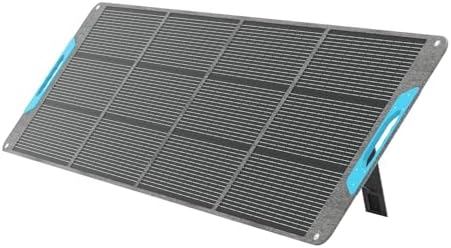


Panels we recommend for most stations
Common questions
Will a bigger panel damage my power station?
Extra watts won’t — the station simply takes what it can. Extra voltage above the limit can trigger a fault or damage the input, so voltage is the number to respect.
Can I use a rooftop (residential) solar panel with a power station?
Many 400W+ rigid panels have a Voc of 37–50V. One can work on a 60V input; two in series won’t. Check the label on the back.
How long will my station take to charge?
Roughly battery Wh ÷ (panel watts × 0.75). The full table is in our buyer’s guide.