Last updated: October 5, 2026 · Ondeacha is reader-supported. We may earn a commission when you buy through links on this page. Learn more.
Solar panel guides 9 articles
Start here
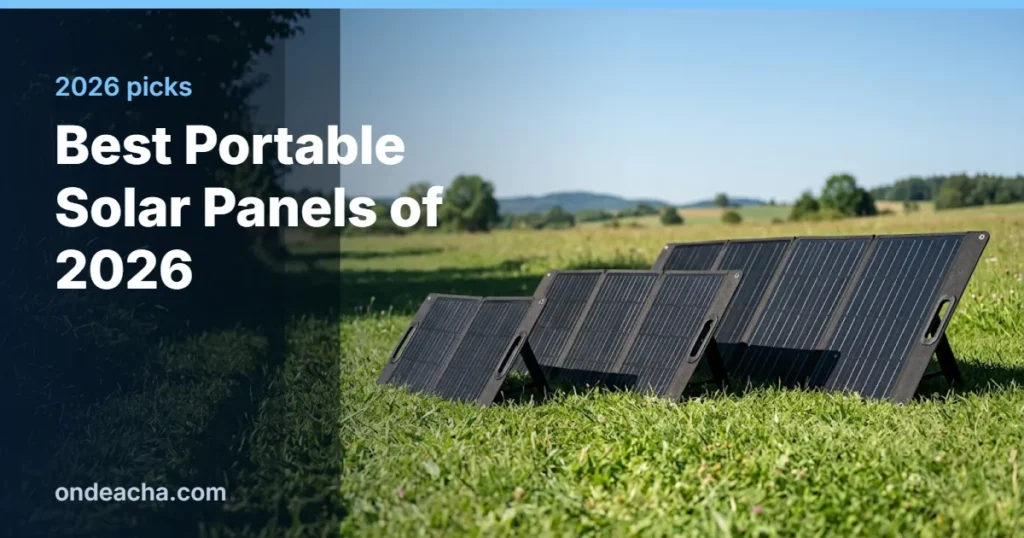
We compared the folding solar panels people actually pair with power stations in 2026, from 7-pound 100W panels to 220W bifacial models. We looked at real-world output, open-circuit voltage (the spec that decides whether a panel works with your station), weight, connectors, water resistance, and warranty. Here are the ones worth your money.
Our picks at a glance
| Pick | Panel | Why |
|---|---|---|
| Best overall | Jackery SolarSaga 200W | 25% TOPCon cells, IP68, USB ports, 3+2-year warranty |
| Best value | BougeRV 200W N-Type | Ships with XT60, DC7909, and DC5521 plugs; fits most stations |
| Best for EcoFlow owners | EcoFlow 220W Bifacial | Plug-and-play XT60, catches light on both sides |
| Lightest 100W | Jackery SolarSaga 100W Air | About 7 lb, folds small enough for a backpack |
| Best middle size | EcoFlow 160W | A good match for 500Wh–1kWh stations |
| Also great | Renogy 200W for Power Stations | N-type cells from a long-time solar brand |




1. Jackery SolarSaga 200W — best overall
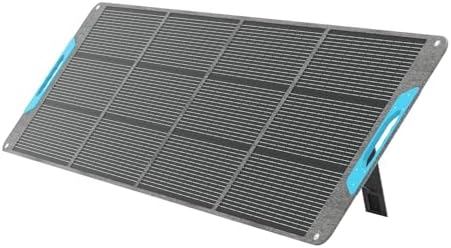
The current SolarSaga 200W uses N-type TOPCon cells rated at 25% efficiency, which keeps it to about 14.3 lb even though it is a full 200W panel (Jackery quotes up to 225W with bifacial gain). It is sealed to IP68, has USB-A and USB-C ports on the panel for charging a phone directly, and carries Jackery’s 3-year warranty plus 2 more years if you register.
- Voc: 22V — safe on almost any station, and two in series (about 44V) still fit 60V inputs.
- Size: folds to about 23.6 × 23.5 × 1.6 in.
- Connector: DC8020 with a DC7909 adapter. Plug-and-play on Jackery Explorer v2 and Plus models; other brands need an adapter.
- Real-world output: about 150W in good sun — enough to refill a 1kWh station in roughly 7 sun-hours.
Skip it if you own an EcoFlow or Anker station and don’t want to deal with adapters.
2. BougeRV 200W N-Type — best value
BougeRV’s foldable 200W uses the same class of 25% N-type cells for well under the price of the big-brand panels. Its biggest strength is the cable kit: it ships with XT60 (EcoFlow, Anker), DC7909 (Jackery older models, BLUETTI), and DC5521 outputs, so it fits most power stations out of the box.
- Voc: about 21V. Weight: 13.8 lb. Folded: about 23.6 × 22.9 × 1.8 in.
- Water resistance: IP65 (fine for splashes and light rain; don’t leave it out in a storm).
- Warranty: 2 years.
3. EcoFlow 220W Bifacial — best for EcoFlow owners
If your station is a RIVER or DELTA, this is the easiest panel to live with: the XT60 cable plugs straight in, the case doubles as a stand, and the back side collects extra light reflected from the ground. EcoFlow rates the front at 220W, with additional output from the rear in bright, reflective conditions. It’s sealed to IP68.
- Voc: about 21.5–21.8V depending on version — one panel works on a RIVER 3; two in series suit a DELTA 3 Plus.
- Weight: about 15.4 lb for the NextGen version and about 21 lb for the original.
- Warranty: 12 months in the U.S., shorter than Jackery’s.
Read our full EcoFlow 220W Bifacial review.
4. Jackery SolarSaga 100W Air — lightest 100W
At about 7.1 lb and roughly 17 × 17 in folded, the 100W Air is the panel you’ll actually bring on a hike or a short trip. It uses bifacial PERC cells rated at 23%, has USB-A and USB-C ports, and a higher Voc (about 29.7V) than most 100W panels.
Watch out: Jackery says it does not work with the Explorer 300, 300D, 240D, or 300 v2. And at 29.7V it sits right at the limit of 30V inputs like the EcoFlow RIVER 3 — not something we’d recommend in cold weather, when Voc rises.
Read our Jackery SolarSaga 100W review for the differences between the Air, Light, and Prime versions.
5. EcoFlow 160W — best middle size
160W is a sweet spot for 500Wh–1kWh stations: noticeably more power than a 100W panel at around 12 lb. The current version uses N-type cells at 25% and is sealed to IP68. Its Voc of about 21V means one panel suits a RIVER 3 and two in series suit most larger stations.
6. Renogy 200W for Power Stations — also great
Renogy has been selling solar gear to RV and off-grid owners for over a decade. Its 200W folding panel for power stations uses N-type cells rated at 25% efficiency and a low, 12V-class voltage that works with nearly every station. Compare the kit contents on the listing: Renogy sells several 200W versions, including suitcase kits with a built-in controller for 12V batteries. Our Renogy guide explains which is which.
What about 400W panels?
400W folding panels (EcoFlow 400W, Anker SOLIX PS400) refill a 1–2kWh station in a single sunny day, but they weigh around 35 lb and run at high voltage (48V or more), so they don’t work with small stations, and two of them in series exceed most 60V inputs. For most people, two 200W panels are easier to carry, more flexible, and similar in cost. If you do go 400W, check our pairing guide first.
Specs side by side
| Panel | Rated | Cells | Voc | Weight | Water | Connector |
|---|---|---|---|---|---|---|
| Jackery SolarSaga 200W | 200W | TOPCon 25% | 22V | 14.3 lb | IP68 | DC8020 (+DC7909) |
| BougeRV 200W N-Type | 200W | N-type 25% | 21V | 13.8 lb | IP65 | XT60 / DC7909 / DC5521 |
| EcoFlow 220W Bifacial | 220W front | Bifacial | 21.5–21.8V | 15.4–21 lb | IP68 | XT60 |
| Jackery SolarSaga 100W Air | 100W | Bifacial PERC 23% | 29.7V | 7.1 lb | See listing | DC8020 (+DC7909) |
| EcoFlow 160W | 160W | N-type 25% | About 21V | About 12 lb | IP68 | XT60 |
Specs from manufacturer pages and major retailers as of October 2026. Versions change; confirm on the listing before buying.
How we chose
- Compatibility first. A panel that doesn’t fit your station’s voltage window is useless, so low, predictable Voc scored well.
- Watts per pound. You will carry it; N-type panels earn their premium here.
- Weather sealing and warranty. IP68 and multi-year coverage beat IP65 and 12 months.
- Owner feedback. We looked for recurring complaints: failed kickstands, broken connectors, and output far below the rating.
Common questions
What size portable solar panel do I need?
For a 1kWh power station, 200W is the practical minimum and 400W (two panels) refills it in a day. For a 250–500Wh station, 100–160W is enough. The math is in our buyer’s guide.
Can I mix brands?
Yes, with the right adapter cable, as long as the voltage fits. Just don’t wire different models in series.
Which power station should I pair it with?
See our best portable power stations of 2026; the 1kWh models there accept 400W to 1,000W of solar.
How we research: specifications come from manufacturer documentation and are cross-checked with retailer listings and published reviews. Read How We Review.