Last updated: October 19, 2026 · Ondeacha is reader-supported. We may earn a commission when you buy through links on this page. Learn more.
Power station guides 26 articles
Start here
By use
- Home backup and power outages
- Apartments (no generator allowed)
- Camping and van life
- RVs and campers (30-amp)
- Running a refrigerator
- CPAP machines
- Starlink and Starlink Mini
- Gas furnace in a winter outage
- Pellet stove in a winter outage
- Space heater runtimes
- Sump pump backup
- Electric blanket all night
- TV, tailgates and movie nights
- Christmas lights
Short answer: for most apartments, a 1kWh LiFePO4 power station (about 1,000–1,100Wh) is the sweet spot. It keeps a Wi-Fi router running for more than two days, a CPAP for about three nights, or a full-size fridge for roughly 12 hours, and it weighs about 24–25 lb, so you can carry it up the stairs. It runs silently indoors with no fumes, which is the whole point: a gas generator is not an option on a balcony or inside a unit. Studio dwellers who only need Wi-Fi, phones and a light can get away with a small 250–300Wh unit.
Why apartments need a different kind of backup
- No gas generators. Fuel-burning generators produce carbon monoxide and must run outdoors, far from windows and doors. Balconies, patios and hallways don’t qualify, and many leases and local fire codes ban generators and fuel storage in multifamily buildings. A battery power station has no exhaust and can sit next to your couch.
- Stairs and small closets. If you live in a walk-up, weight matters more than anywhere else. Storage space is tight too, so a compact box beats a 100 lb home battery.
- Neighbors. Power stations are close to silent; you’ll only hear a cooling fan under heavy load.
- Charging. You’ll recharge from a wall outlet before a storm and, optionally, from a folding balcony solar panel during a long outage.
How long will it run? (apartment devices)
We use runtime ≈ capacity (Wh) × 0.85 ÷ device watts. The 0.85 accounts for inverter losses. Device watts below are typical figures; check the label on yours.
| Device (typical draw) | 245Wh (RIVER 3) | 1,024Wh (C1000 Gen 2 / DELTA 3 Plus) | 2,042Wh (Explorer 2000 v2) |
|---|---|---|---|
| Wi-Fi router + modem (15W) | about 14 hours | about 58 hours | about 116 hours |
| LED lamp (10W) | about 21 hours | about 87 hours | about 174 hours |
| CPAP, no humidifier (40W) | about 5 hours | about 22 hours | about 43 hours |
| Laptop (60W) | about 3.5 hours | about 14.5 hours | about 29 hours |
| 55″ LED TV (100W) | about 2 hours | about 8.7 hours | about 17 hours |
| Full-size fridge (about 70W average) | not recommended (300W limit) | about 12 hours | about 25 hours |
A realistic outage night: fridge (70W average) + router (15W) + phones and a laptop (about 25W average) + one lamp (10W) is roughly 120W. A 1,024Wh unit covers that for about 7 hours; a 2,042Wh unit for about 14.5 hours. If you can live without the fridge for part of the night (a closed fridge stays cold for about 4 hours), the same battery stretches much further. Our fridge runtime guide and size calculator go deeper.
Best portable power stations for apartments
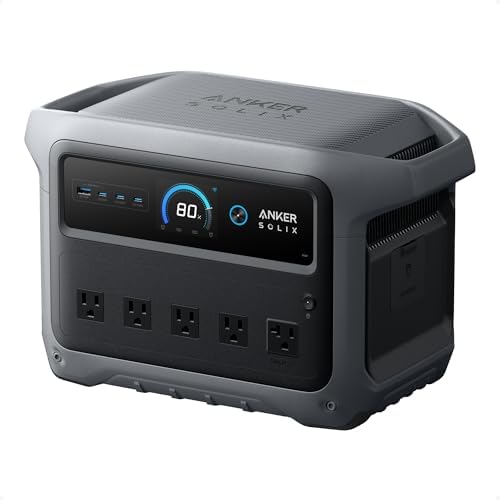
1. Anker SOLIX C1000 Gen 2 — Best overall for apartments
Key specs: 1,024Wh LiFePO4 · 2,000W continuous, 3,000W surge · 24.9 lb · 600W solar · 5 AC outlets · 10ms UPS · 5-year warranty
The best all-rounder for a one- or two-bedroom apartment. 2,000W of output covers a fridge’s start-up surge, a coffee maker or a microwave, and the 10ms UPS mode lets it sit permanently behind your router or CPAP so they never notice an outage. At just under 25 lb it’s manageable on stairs.
2. Jackery Explorer 1000 v2 — Best for walk-ups
Key specs: 1,070Wh LiFePO4 · 1,500W continuous, 3,000W surge · 24 lb · 400W solar · 3 AC outlets · 3-year warranty
The lightest 1kWh unit on our list, with slightly more capacity than the Anker. The trade-off is lower continuous output (1,500W) and only three AC outlets, which is fine for a fridge, router, lights and phones but not for a full-power space heater or a large microwave.
3. EcoFlow DELTA 3 Plus — Best with a balcony solar panel
Key specs: 1,024Wh LiFePO4 · 1,800W continuous (2,200W X-Boost) · 27.6 lb · 1,000W solar (two inputs) · 6 AC outlets · under 10ms UPS · 5-year warranty · expandable
If you have a sunny balcony, this is the one to pair with a folding panel. Two solar inputs and add-on batteries mean it can grow with you. With a 200W panel in full sun, solar time ≈ 1,024 ÷ (200 × 0.75) ≈ 7 hours; on a shaded balcony expect much longer. See our solar panels for apartments guide.
4. EcoFlow RIVER 3 — Best for studios and small budgets
Key specs: 245Wh LiFePO4 · 300W continuous (600W X-Boost) · 7.8 lb · 110W solar · 2 AC outlets · under 20ms UPS · 5-year warranty
Fits on a bookshelf and keeps the essentials alive: about 14 hours of Wi-Fi, a night of CPAP without the humidifier, and plenty of phone charges. It won’t run a fridge, so treat it as a communications-and-light kit.

5. Jackery Explorer 2000 v2 — Best for long outages
Key specs: 2,042Wh LiFePO4 · 2,200W continuous, 4,400W peak · 39.5 lb · 400W solar · 3 AC outlets · under 20ms UPS
Two kilowatt-hours is enough to keep a full-size fridge running for about a day, or a router and CPAP going through a multi-day outage. It’s heavy for a fourth-floor walk-up, but it’s still a fraction of the size of a home battery.

Compare the 1kWh options on Amazon


Which size fits your apartment?
| Your situation | Size to look at | Pick |
|---|---|---|
| Studio, Wi-Fi + phones + light | 250–300Wh | EcoFlow RIVER 3 |
| CPAP user, short outages | 500Wh–1kWh | Any 1kWh pick (see our CPAP guide) |
| 1–2 bedrooms, fridge + Wi-Fi overnight | about 1kWh | Anker C1000 Gen 2 or Jackery 1000 v2 |
| Sunny balcony, multi-day outages | 1kWh + 100–200W panel | EcoFlow DELTA 3 Plus |
| Frequent long outages, fridge all day | about 2kWh | Jackery Explorer 2000 v2 |
Apartment tips
- Use UPS mode for the router. Plug the modem and router into the power station and the power station into the wall. When the grid drops, Wi-Fi stays up.
- Skip the space heater. A 1,500W heater drains a 1kWh unit in well under an hour. An electric blanket uses a fraction of that; see our space heater math for the numbers.
- Keep it charged. Store it in a closet and top it up every few months, and fully charge it when a storm is in the forecast.
- Don’t run cords through hallways. Everything stays inside your unit, which is one more reason a battery beats a generator here.
- Buying soon? Prices on these units usually drop around Black Friday; our Black Friday guide lists price-per-Wh targets.
Common questions
Can I use a portable power station inside an apartment?
Yes. Battery power stations have no engine and no exhaust, so they’re designed for indoor use. Keep the vents clear and follow the manufacturer’s manual. Gas, propane and dual-fuel generators are a different story: they must run outdoors, away from windows and doors.
Can I run a generator on my apartment balcony?
No. Carbon monoxide from a generator on a balcony can drift into your unit or your neighbors’. Many leases and local fire codes also prohibit generators and fuel storage in apartment buildings. A power station is the practical alternative; see power station vs. generator.
What size power station do I need for an apartment?
Add up the watts of what you’ll run and multiply by the hours you need, then divide by 0.85. Wi-Fi and phones only: about 250–300Wh. Fridge overnight: about 1kWh. Fridge for a full day: about 2kWh.
Can I charge it with solar on a balcony?
Yes, with a folding panel leaned against the railing or set on the floor. South-facing balconies work best; shaded or north-facing ones may only trickle-charge. Check your building’s rules before mounting anything.