Last updated: October 5, 2026 · Ondeacha is reader-supported. We may earn a commission when you buy through links on this page. Learn more.
Solar panel guides 9 articles
Start here
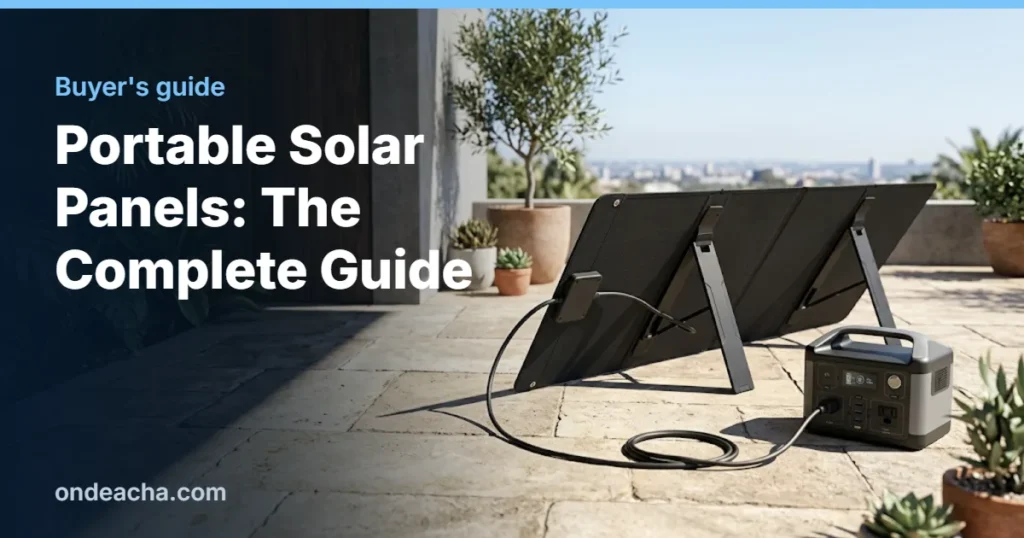
A portable solar panel is a folding panel you set up in the sun and plug into a power station, a 12V battery, or your phone. No roof, no installer, no permit. Fold it up, put it in the car, and you have free power at the campsite, in the RV, on a balcony, or in your yard during a long outage.
The catch: a “200W” panel almost never gives you 200 watts, and a panel that works great with one power station can be useless with another. This guide explains the few numbers that matter, how much charging you will really get, and which guide to read next.
Quick answers
- Just want a recommendation? See the best portable solar panels of 2026.
- Already own a power station? Read how to pick a panel that actually works with it.
- Camping or RV? Go to camping or RV.
- Renting? See solar panels for apartments and balconies.
Top portable solar panels right now
The six panels we compare most. Prices and photos update live from Amazon; see our full ranking.




How a portable solar panel works
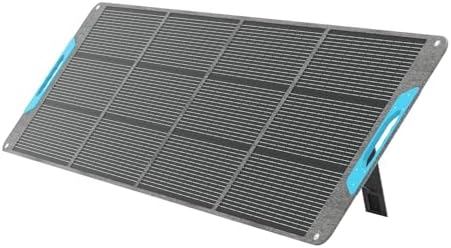
Each panel is a set of silicon cells that turn sunlight into direct current (DC). Folding panels split those cells across two to four hinged sections in a fabric or plastic case, with a kickstand on the back so you can tilt them toward the sun. A cable carries the power to whatever you are charging.
Most portable panels do not have a charge controller built in. Your power station has one inside, which is why “panel + power station” (often sold as a “solar generator”) is the simplest setup. If you charge a bare 12V battery instead, you need a separate controller, or a “solar suitcase” that includes one.
The 6 numbers that actually matter
1. Rated watts (W) and real-world watts
The wattage on the box is measured in a lab: full sun at 1,000 W/m² and a cell temperature of 77°F (25°C). Outdoors, with heat, haze, dust, and a less-than-perfect angle, expect about 70–80% of the rating. A 200W panel usually gives you 140–160W on a good summer day. Plan with 75%.
2. Open-circuit voltage (Voc)
Voc is the highest voltage the panel puts out. It is the number most people skip and the one that can stop you cold: every power station has a maximum solar input voltage. If the panel’s Voc (or two panels in series) is above it, the station will refuse to charge or flag an error. Voc also rises in cold weather, so leave a 10–15% margin.
3. Current (amps)
Stations also cap input current. A panel with plenty of watts but low voltage can hit the amp limit before it reaches its rated power. Example: the Anker SOLIX C1000 Gen 2 accepts 600W, but only at 29–60V; between 11V and 28V it is limited to 8.2A, which caps a single 12V-class panel at roughly 230W.
4. Cell type and efficiency
Newer panels use N-type (TOPCon) cells at around 25% efficiency. They lose a bit less power in heat than older PERC cells, and they make a panel smaller and lighter for the same watts. Bifacial panels also collect light on the back, which helps a little over sand, snow, or a white surface.
5. Connector
Jackery uses DC8020 (with a DC7909 adapter), EcoFlow uses XT60/XT60i, and most third-party panels ship with MC4 leads and a bag of adapters. The right cable costs $15–$40 if the panel doesn’t include it, but check before you buy.
6. Weight, folded size, and water resistance
100W panels weigh about 7–10 lb and fold to roughly the size of a large laptop bag. 200–220W panels weigh 14–21 lb. 400W panels are about 35 lb and are best treated as “car-portable.” For rain, IP67/IP68 means the panel itself is well sealed; IP65 handles splashes.
How long will solar take to charge my power station?
A simple rule of thumb:
Charging time (sun-hours) ≈ Battery Wh ÷ (Panel watts × 0.75)
| Battery | 1 × 100W panel | 1 × 200W panel | 2 × 200W panels |
|---|---|---|---|
| 250Wh (e.g. EcoFlow RIVER 3) | About 3.3 hours | Capped by the station’s input (110W on RIVER 3) | Not compatible in series |
| 1,024–1,070Wh (1kWh class) | About 14 hours (2–3 days) | About 7 hours | About 3.5 hours |
| 2,042Wh (e.g. Jackery 2000 v2) | About 27 hours | About 14 hours | About 7 hours |
Most of the U.S. gets 4–6 peak sun-hours a day in summer and 2–4 in winter, so “7 sun-hours” is usually one full sunny day.
Sizes at a glance
| Panel size | Typical weight | Good for |
|---|---|---|
| 40–100W | 3–10 lb | Phones, lights, topping up a 250–500Wh station, backpacking |
| 160–220W | 12–21 lb | Weekend camping, keeping a 1kWh station running, Starlink Mini |
| 400W (or 2 × 200W) | 28–36 lb | RVs, outages, refilling a 1–2kWh station in a day |
Setup tips that add 25% or more
- Point it at the sun and re-aim. A panel tilted 30° off the sun loses 10–15%. Moving it every 2–3 hours can raise the daily total by a quarter or more.
- Avoid partial shade. A shadow from a branch across a single cell can cut output by half. Move the panel rather than accept “mostly sunny.”
- Keep it cool. Panels lose about 0.3–0.5% of output for every °C (roughly 0.2–0.3% per °F) the cells run above 77°F, and cells on a hot day easily run 40°F hotter than the air. Give the back some airflow; don’t lay it flat on hot asphalt.
- Use the shortest cable that works. Long, thin extension cables waste power.
- Don’t mix panel models in series. The weakest panel drags the string down.
Portable panels vs. the alternatives
| Option | Pros | Cons |
|---|---|---|
| Folding portable panel | No install, moves with you, aim it at the sun | Set up and take down every time; can be stolen |
| Rigid panel (roof or ground mount) | Cheaper per watt, lasts decades | Needs mounting; heavy |
| Flexible adhesive panel | Thin, sticks to curved RV/boat roofs | Runs hot, shorter life |
| Rooftop home solar | Huge output, cuts your bill | Expensive, permits, not portable |
Common questions
Are portable solar panels worth it?
If you already own a power station, yes: a panel turns a battery that lasts a day into one that keeps going as long as the sun shows up. They are worth less if you only need backup for a few hours a year and can recharge from the wall or a car.
Can I use any solar panel with any power station?
No. The panel’s voltage must sit inside the station’s input range and the connector must match or be adapted. Our pairing guide lists the limits for popular models.
Do portable solar panels work on cloudy days?
They still produce power, but usually 10–25% of their sunny-day output. Plan your setup around clear days and treat cloudy days as a bonus.
Can I leave a portable panel outside?
For a few days, a sealed (IP67/IP68) panel is fine. They are not built to stay out for months like a roof panel; wind can flip a folding panel, and UV slowly wears the fabric case.
Our guides to portable solar panels
- Best Portable Solar Panels of 2026 — our ranked picks from 100W to 220W, with real-world output.
- How to Choose a Solar Panel for Your Power Station — voltage, amps, connectors, and series vs. parallel.
- Best for Camping — light panels and how much solar a weekend needs.
- Best for RVs — portable panels instead of drilling the roof.
- Apartments and Balconies — what a renter can realistically power.
- Jackery SolarSaga 100W Review — which of the 100W versions to buy.
- EcoFlow 220W Bifacial Review — is the two-sided panel worth it?
- Renogy Portable Solar Panels — the 100W, 200W, and suitcase kits explained.
Pairing with a battery? Start with our portable power station buyer’s guide and best power stations of 2026.
How we research: specifications come from manufacturer documentation and are cross-checked with retailer listings and published reviews. Read How We Review.