
Last updated: October 5, 2026 · Ondeacha is reader-supported. We may earn a commission when you buy through links on this page. Learn more.
Solar panel guides 9 articles
Start here
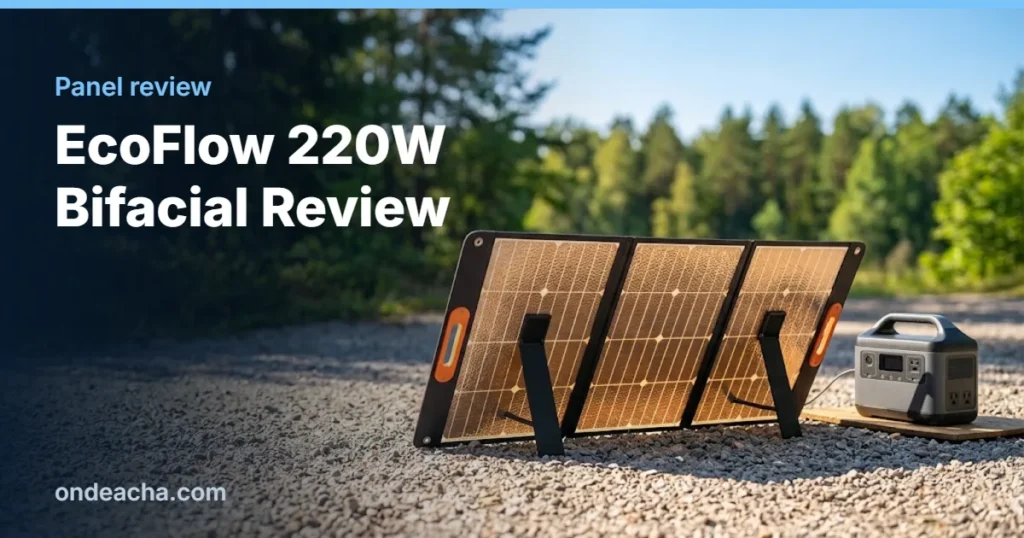
The EcoFlow 220W Bifacial is the panel EcoFlow bundles with most of its DELTA and RIVER “solar generator” kits, and the one EcoFlow owners ask about most. It has cells on both sides, an XT60 cable that plugs straight into EcoFlow stations, and a case that turns into a stand. Here’s what it does well, where it falls short, and who should buy something else.
The verdict
Buy it if you own an EcoFlow station and want a panel that just works: one panel suits a RIVER 3, two in series suit a DELTA 3 or DELTA 3 Plus, and the IP68 sealing means a rain shower isn’t a crisis. Look elsewhere if you own a Jackery (different plug) or if you’ll carry it far — the original version weighs about 21 lb.

Key specs
| Original 220W Bifacial | NextGen 220W Bifacial | |
|---|---|---|
| Rated power | 220W front, 155W rear | 220W front, 175W rear |
| Cells | Monocrystalline, 22–23% | N-type TOPCon, about 25% |
| Open-circuit voltage (Voc) | 21.8V | 21.5V |
| Short-circuit current | 13A | 12.4A |
| Weight | About 20.9 lb | About 15.4 lb |
| Folded size | — | About 24.2 × 23.2 × 1.3 in |
| Water resistance | IP68 (per listing) | IP68 |
| Stand | Case doubles as stand | Built-in 30–60° stand with angle guide |
| Warranty (U.S.) | 12 months | 12 months |
Sources: EcoFlow U.S. product pages and authorized retailer spec sheets, October 2026. Check which version the listing ships before buying; the NextGen is noticeably lighter.
What “bifacial” really adds
The rear rating (155–175W) is measured under ideal reflected light. On grass or dark dirt, the back side adds very little. Over light sand, snow, concrete, or a white tarp, a bifacial panel typically gains a modest extra 5–15% over the same panel without rear cells. It’s a nice bonus, not a reason to expect 375W.
Tip: put a white or silver tarp under the panel at the campsite. It’s the cheapest way to make bifacial gain real.
What’s good
- Plug-and-play with EcoFlow. XT60 cable included; no adapters.
- Low voltage. At about 21.5V, one panel fits the RIVER 3’s 30V input, and two in series (about 43V) fit the DELTA line’s 60V inputs.
- IP68. Better sealed than IP65 rivals.
- Angle guide (NextGen) makes it easy to aim correctly.
What’s not
- Heavy (original version). About 21 lb is a lot for a 220W panel; the BougeRV 200W and Jackery SolarSaga 200W are about 14 lb.
- Short warranty. 12 months in the U.S., versus up to 5 years for Jackery with registration.
- RIVER 3 can’t use all of it. The RIVER 3 accepts only 110W of solar. For that station, the 160W (or even a 100W panel) is a better fit.
Charge times with EcoFlow stations
| Station | Capacity | 1 × 220W | 2 × 220W |
|---|---|---|---|
| RIVER 3 | 245Wh | About 3 hours (capped at 110W input) | Not supported |
| DELTA 3 Plus | 1,024Wh | About 6–7 sun-hours | About 3–3.5 sun-hours |
Estimate: capacity ÷ (panel watts × 0.75), limited by the station’s input.
Alternatives
- Lighter and cheaper for any brand: BougeRV 200W N-Type (13.8 lb, multiple plugs).
- Smaller EcoFlow panel: EcoFlow 160W — better match for a RIVER 3.
- Jackery owners: Jackery SolarSaga 200W.


Common questions
Does the EcoFlow 220W work with non-EcoFlow stations?
Yes, with an XT60-to-your-plug adapter, as long as the station accepts about 22V. It works well on Anker SOLIX stations, which also use XT60.
Can I connect two EcoFlow 220W panels?
Yes. EcoFlow recommends series for DELTA stations. Don’t do it on a RIVER 3.
Is the 220W better than EcoFlow’s 400W?
For carrying, yes. The 400W (about 35 lb, 48V) charges a DELTA faster but won’t work on small stations. Two 220W panels give you similar output and more flexibility.