Last updated: October 12, 2026 · Ondeacha is reader-supported. We may earn a commission when you buy through links on this page. Learn more.
Power station guides 26 articles
Start here
By use
- Home backup and power outages
- Apartments (no generator allowed)
- Camping and van life
- RVs and campers (30-amp)
- Running a refrigerator
- CPAP machines
- Starlink and Starlink Mini
- Gas furnace in a winter outage
- Pellet stove in a winter outage
- Space heater runtimes
- Sump pump backup
- Electric blanket all night
- TV, tailgates and movie nights
- Christmas lights
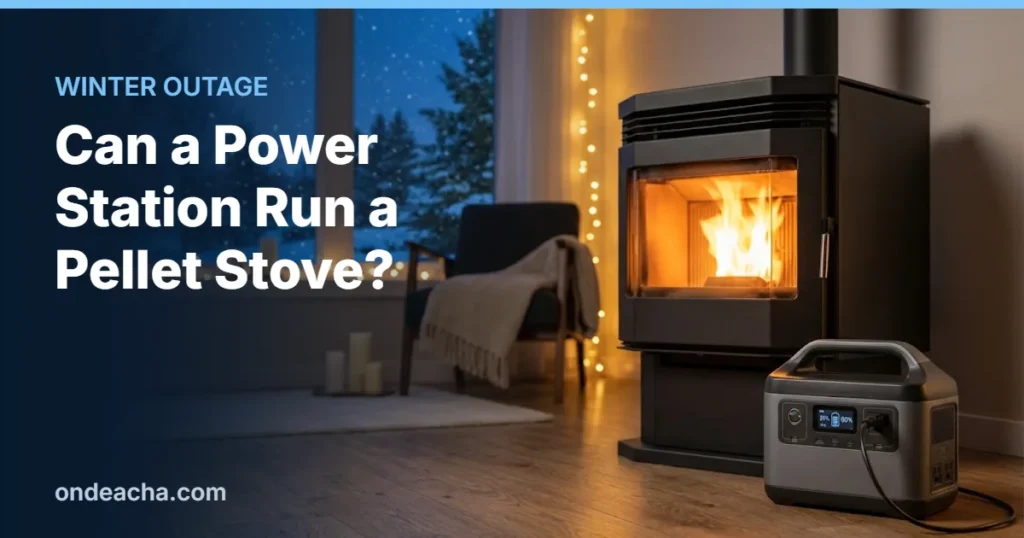
Short answer: yes. A pellet stove is one of the easiest heaters to keep running in a winter outage, because the pellets make the heat and the electricity only runs the auger, the fans, and the controls. Once it is lit, most stoves draw roughly 75–150W, so a 1kWh power station can keep one going for about 6–11 hours, and a 2kWh unit can get you through a whole night. The catch is the igniter: an automatic start can pull about 300–650W for several minutes, so the station needs enough output to handle it.
Safety first: a pellet stove needs power to keep its exhaust (combustion) fan running. If power cuts out mid-burn, smoke can back up into the room. Keep a working carbon monoxide detector on every level of your home, follow your stove manual’s power-outage instructions, and never run a gas generator indoors or in a garage.


How much power does a pellet stove use?
Check the label on the back of your stove or the manual for the exact amps, then multiply by 120V. Owner measurements and manufacturer guides put most stoves in these ranges:
| Component | Typical draw | When |
|---|---|---|
| Hot-rod / hot-air igniter | About 300–500W (some stoves more) | Several minutes at each automatic start |
| Combustion (exhaust) fan | About 30–100W | Always while burning |
| Room (convection) blower | About 80–150W | While heating, depends on fan speed |
| Auger motor | About 20–40W | On and off, feeding pellets |
| Control board | Under 15W | Always |
Put together, a typical stove runs at about 75–150W once it’s lit, with some larger stoves on high fan reaching 200W or more. The start-up is the expensive part: one owner measured a Harman P61A at 372W during ignition and 128–152W while running.
What size power station do you need?
Output
If you’ll use automatic ignition on battery, choose a station with at least 1,000W continuous output (1,500W+ gives comfortable margin). If you light the stove manually or it’s already burning when the power goes out, almost any modern 1kWh unit has enough output.
Capacity and runtime
Using runtime ≈ capacity × 0.85 ÷ average watts:
| Power station | At 80W (low fan) | At 120W (typical) | At 150W (high fan) |
|---|---|---|---|
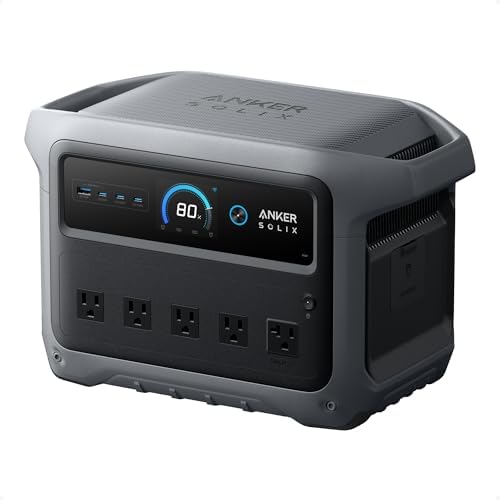
| 1kWh class (Anker SOLIX C1000 Gen 2, EcoFlow DELTA 3 Plus) | About 11 hours | About 7 hours | About 5.8 hours |
| Jackery Explorer 2000 v2 (2,042Wh) | About 21.7 hours | About 14.5 hours | About 11.6 hours |
| EcoFlow DELTA Pro 3 (4,096Wh) | About 43 hours | About 29 hours | About 23 hours |
Each automatic ignition costs extra: at around 500W for 15 minutes, that’s roughly 125Wh per start. Keeping the stove burning steadily on a low setting instead of letting it cycle off and relight saves a lot of battery.
How to connect a pellet stove to a power station
- Plug it in directly. Unlike most furnaces, nearly all pellet stoves use a normal 120V plug. Run it straight into one of the station’s AC outlets.
- Use pass-through (UPS) mode. Leave the stove plugged into the power station and the station plugged into the wall. When the grid drops, a station with a fast switchover keeps the combustion fan spinning, so the stove never loses its draft. The Anker SOLIX C1000 Gen 2, for example, lists a 10ms UPS switchover.
- Turn off auto-ignite on battery if your stove allows it, and light it manually. Several stove makers recommend this when running on backup power, and it saves the igniter’s energy for later.
- Stick to pure sine wave. Stove control boards and fan motors expect clean power. All the current power stations we recommend use pure sine wave inverters; avoid cheap modified-sine inverters.
Our picks for running a pellet stove
- Keep the stove safe through short outages: Anker SOLIX C1000 Gen 2 — 1,024Wh, 2,000W output, 10ms UPS switchover.
- A full night of heat: Jackery Explorer 2000 v2 — 2,042Wh, enough for 11+ hours even on high fan.
- Multi-day winter outages: EcoFlow DELTA Pro 3 — 4,096Wh (expandable), recharge from solar or an outdoor generator during the day.
Prices on these change daily and drop around Black Friday; see our Black Friday target prices before you buy, or compare everything in our best power stations roundup.
Common questions
Will a 500W power station run a pellet stove?
It can usually keep a stove that is already lit running, since most draw well under 200W. It may not handle the igniter on start-up, so you’d need to light the stove manually.
Is a UPS or a power station better for a pellet stove?
A small computer UPS is designed for minutes, not hours: owners report 30 minutes to about 2 hours from 1,500–2,200VA units. A portable power station holds far more energy (1–4kWh), recharges from solar panels, and can also run your fridge or phone chargers.
Can I recharge the power station while the stove is running?
Yes. Most stations charge and output at the same time. During a long outage, recharge by day with solar panels or a generator placed outdoors at least 20 feet from the house.
What about a pellet grill?
Pellet grills use the same parts (igniter, auger, fan) and similar power, so the same math applies — but they’re for cooking outdoors, not heating.