Last updated: October 7, 2026 · Ondeacha is reader-supported. We may earn a commission when you buy through links on this page. Learn more.
Power station guides 26 articles
Start here
By use
- Home backup and power outages
- Apartments (no generator allowed)
- Camping and van life
- RVs and campers (30-amp)
- Running a refrigerator
- CPAP machines
- Starlink and Starlink Mini
- Gas furnace in a winter outage
- Pellet stove in a winter outage
- Space heater runtimes
- Sump pump backup
- Electric blanket all night
- TV, tailgates and movie nights
- Christmas lights
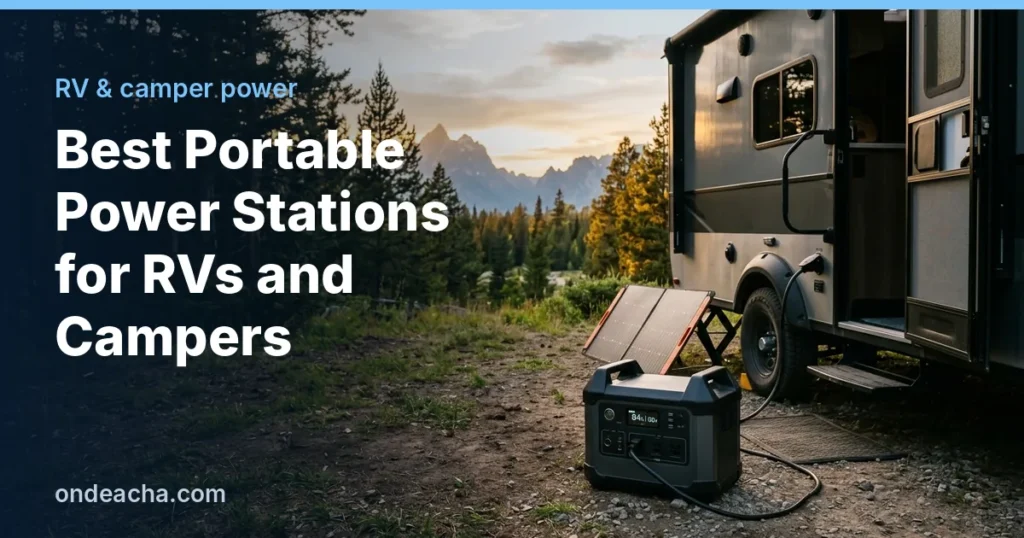
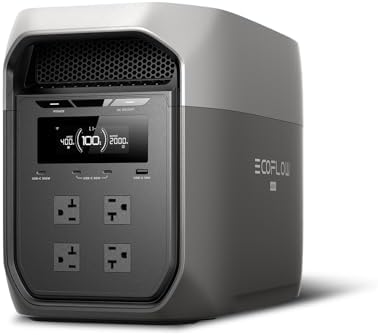
Short answer: a portable power station can run most of an RV or camper — lights, water pump, fans, a 12V or residential fridge, TV, CPAP, laptops, even a coffee maker — quietly and with no fumes. For a weekend of boondocking, a 2kWh unit with 2,000W+ output is the sweet spot. If you want to plug your 30-amp RV cord straight in and occasionally run the roof air conditioner, you need a 4kWh-class unit with a TT-30 RV outlet, like the EcoFlow DELTA Pro 3.


What can a power station run in an RV?
Check the label on each appliance for watts (or amps × 120). Typical numbers:
| RV load | Typical draw | Notes |
|---|---|---|
| LED lights (whole rig) | 20–50W | Easy |
| Water pump | 40–80W | Short bursts |
| Vent / roof fan | 15–40W | Easy |
| 12V compressor fridge | 40–60W when running | Cycles on and off |
| Residential fridge (120V) | 100–200W running, higher start-up | Biggest all-day load |
| TV + streaming box | 50–120W | Easy |
| CPAP (no heated humidifier) | 30–60W | See our CPAP guide |
| Coffee maker / microwave | 800–1,500W | Short use; needs 1,800W+ output |
| Roof A/C (13,500 BTU) | About 1,200–1,600W running, 2,500W+ to start | Needs a large unit; a soft-start kit helps |
How much capacity do you need?
Add up a day of use. A typical camper day without air conditioning looks like this:
| Load | Use | Energy |
|---|---|---|
| LED lights 30W | 5 hours | 150Wh |
| Water pump 60W | 30 minutes | 30Wh |
| Laptop and phones 60W | 3 hours | 180Wh |
| TV 60W | 3 hours | 180Wh |
| CPAP 40W | 8 hours | 320Wh |
| Coffee maker 1,000W | 15 minutes | 250Wh |
| Total | About 1,110Wh |
Add a 12V fridge (often 400–600Wh a day) and you’re near 1,500–1,700Wh. That’s why a 2kWh unit covers a full day for most couples, while a 1kWh unit suits a small camper, van or weekend with lighter loads.
Runtime at a steady average load
Runtime ≈ capacity × 0.85 ÷ average watts (the 0.85 covers inverter losses).
| Power station | 150W average | 300W average | 600W average |
|---|---|---|---|
| 1kWh class (Anker C1000 Gen 2, EcoFlow DELTA 3 Plus) | About 5.8 hours | About 2.9 hours | About 1.5 hours |
| Jackery Explorer 2000 v2 (2,042Wh) / EcoFlow DELTA 3 Max (2,048Wh) | About 11.6 hours | About 5.8 hours | About 2.9 hours |
| EcoFlow DELTA Pro 3 (4,096Wh) | About 23 hours | About 11.6 hours | About 5.8 hours |
Can a power station run an RV air conditioner?
Yes, but only a big one, and not for long. A 13,500 BTU roof unit draws roughly 1,300W while the compressor runs. If it cycles about half the time on a warm evening, the average is around 650W — about 5.4 hours on a 4,096Wh DELTA Pro 3, and under 3 hours on a 2kWh unit. The start-up surge is the other hurdle: a soft-start kit on the A/C cuts that spike and makes it far more likely to start on a battery. For all-day cooling, plan on solar plus a generator, or campground hookups.
How to connect a power station to your RV
- Plug the shore power cord into a TT-30 outlet. The cleanest setup. A 30-amp RV cord plugs straight into a station with a NEMA TT-30R outlet (the DELTA Pro 3 has one), and your RV’s outlets and circuits work as usual.
- Use a 30A-to-15A adapter (dogbone). With a smaller station, plug the RV cord into a standard household outlet through an adapter. Your rig is then limited to that outlet’s output, so run one big appliance at a time.
- Plug appliances in directly. For the fridge, CPAP or TV, simply plug them into the station — no adapters needed.
Important: when the RV is fed from a power station, switch off the converter/charger breaker. Otherwise the converter tries to charge your house battery from the station and quietly burns through hundreds of watt-hours. A 50-amp RV needs a 50A-to-30A adapter, and you’ll still be limited to what the station can deliver.
Our picks for RVs and campers
Best for plugging in a 30-amp RV: EcoFlow DELTA Pro 3
4,096Wh LiFePO4, 4,000W continuous and 8,000W surge, with a NEMA TT-30R RV outlet plus a 120/240V L14-30R outlet. It’s the only pick here that takes your RV cord directly and has a real chance at running the roof A/C. The catch is weight: about 114 lb, so it rides on its built-in wheels and stays put.

Best all-round for boondocking: Jackery Explorer 2000 v2
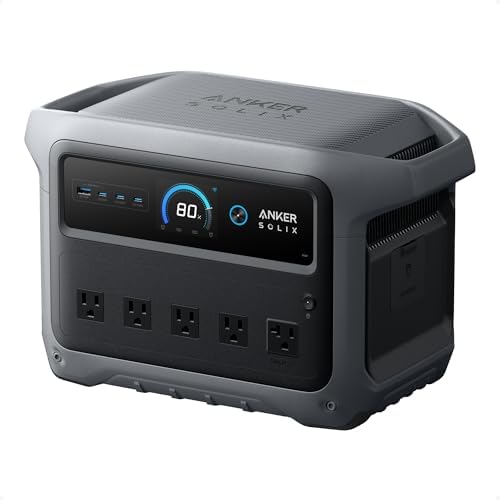
2,042Wh, 2,200W continuous and 4,400W peak in a 39.5 lb package — about a full day of typical camper use. It handles the coffee maker and microwave, and it’s light enough to move between the RV, the campsite and the house. Read our full Jackery 2000 v2 review.

Best 2kWh for solar charging: EcoFlow DELTA 3 Max
2,048Wh, 2,400W continuous and 3,600W surge, with up to 500W of solar input — roughly 5.5 hours of good sun to refill from empty. A strong choice if you camp for days off-grid and want to top up from panels. It weighs about 44.7 lb.
Best for small campers and vans: EcoFlow DELTA 3 Plus or Anker SOLIX C1000 Gen 2
Both hold 1,024Wh. The DELTA 3 Plus (1,800W output, 500W solar input, about 2.7 hours of sun to refill) is better if you charge mainly from solar; the Anker C1000 Gen 2 (2,000W, 3,000W surge) has more muscle for a coffee maker or microwave. Compare them head to head in Anker C1000 Gen 2 vs. DELTA 3 Plus.
Recharging on the road
- Solar: the most popular RV setup. Solar charge time ≈ capacity ÷ (panel watts × 0.75). See portable solar panels for RVs and matching panels to your power station.
- Campground hookup or generator: wall charging is the fastest way to refill between dry-camping stretches.
- Driving: the 12V car outlet adds only around 100W, so treat it as a top-up, not a main source.
Common questions
Can I plug my RV into a portable power station?
Yes. Use a station with a TT-30R outlet for a direct 30-amp connection, or a 30A-to-15A adapter into a standard outlet on smaller units. Turn off the converter/charger breaker first so you don’t drain the station charging the house battery.
Is a power station better than a generator for RV camping?
For quiet hours, small loads and campgrounds with generator rules, yes — it’s silent and fume-free. For all-day air conditioning, a generator or hookup still wins. Many RVers pair both. See power station vs. generator.
What size solar generator do I need for a 30-amp RV?
To feed a 30-amp RV like shore power, look for 3,000W+ output, a TT-30R outlet and 3kWh or more of capacity. A 2kWh unit works for a 30-amp RV too, as long as you skip the A/C and run big appliances one at a time.
Will a power station run my RV fridge overnight?
Yes. A 12V compressor fridge or residential fridge averaging 60–100W runs all night on a 1kWh unit. More detail in can a power station run a refrigerator.