Last updated: October 6, 2026 · Ondeacha is reader-supported. We may earn a commission when you buy through links on this page. Learn more.
Power station guides 26 articles
Start here
By use
- Home backup and power outages
- Apartments (no generator allowed)
- Camping and van life
- RVs and campers (30-amp)
- Running a refrigerator
- CPAP machines
- Starlink and Starlink Mini
- Gas furnace in a winter outage
- Pellet stove in a winter outage
- Space heater runtimes
- Sump pump backup
- Electric blanket all night
- TV, tailgates and movie nights
- Christmas lights
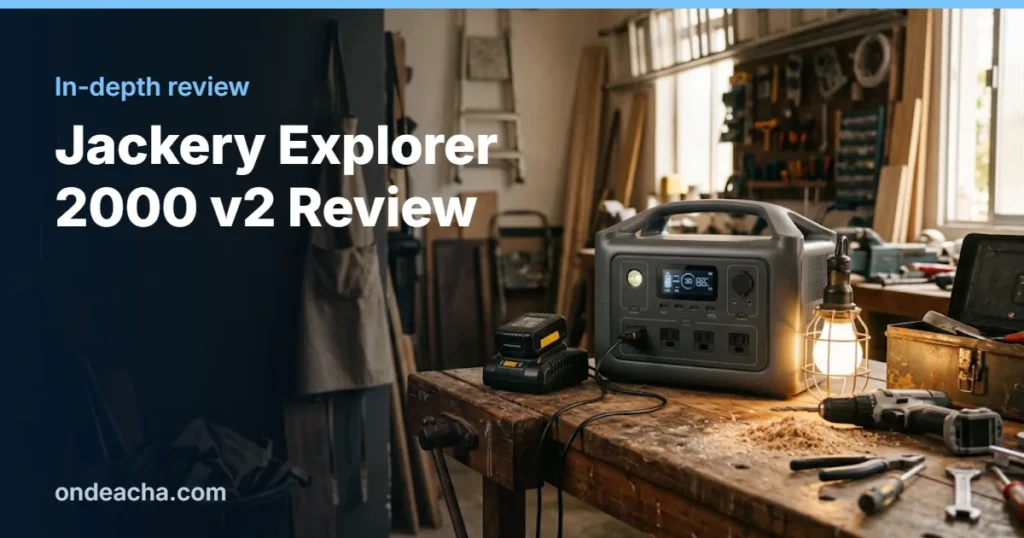
The Jackery Explorer 2000 v2 doubles the battery of the popular 1kWh class while staying a single, carryable box. It has 2,042Wh of LiFePO4 storage, 2,200W of output, and a 39.5-lb body — lighter than many 2kWh rivals. It’s aimed at people who want real outage backup (fridge, internet, CPAP, furnace blower) without stepping up to a 100-lb expandable system. Here’s what the specs mean in practice, where it falls short, and what to buy instead if it doesn’t fit.
The verdict
- Buy it if you want 2kWh of backup in one box you can lift, mainly for outages and RV trips, and you value Jackery’s 3+2-year warranty.
- Skip it if you plan to recharge mainly from solar (400W max input is low for a 2kWh battery), need 240V, or want to add expansion batteries later.

Key specs
| Capacity | 2,042Wh (LiFePO4) |
| Battery life | 4,000 cycles to 70% capacity |
| AC output | 2,200W continuous, 4,400W surge |
| Outlets | 3 × 120V AC, 1 × USB-C 100W, 1 × USB-C 30W, 1 × USB-A 18W, 1 × 12V car port (10A) |
| AC charging | About 2 hours with fast charging |
| Solar input | 400W max, 2 inputs (11–16V at 8A or 16–60V at 12A) |
| UPS switchover | 20 ms or less |
| Weight | 39.5 lb |
| Size | 13.2 × 10.4 × 11.5 in |
| Operating temperature | 32–113°F |
| App | Wi-Fi + Bluetooth |
| Expandable | No |
| Warranty | 3 years + 2 with registration |
From Jackery and authorized U.S. retailer listings, October 2026.
What it runs, and for how long
Runtime ≈ 2,042Wh × 0.85 ÷ watts — roughly 1,735Wh of usable AC energy.
| Load | Typical draw | Runtime |
|---|---|---|
| Wi-Fi router + modem | 20W | About 3.5 days |
| CPAP, no humidifier | 40W | About 43 hours (5 nights) |
| Full-size fridge (daily average) | 60W | About 29 hours |
| Electric blanket, medium | 75W | About 23 hours |
| 55″ TV + streaming | 85W | About 20 hours |
| Gas furnace blower (averaged) | 250W | About 7 hours |
| Space heater on low | 750W | About 2.3 hours |
| Space heater on high | 1,500W | About 1.2 hours |
The practical takeaway: for a typical overnight outage, it keeps the fridge, internet, phones, lights, and a CPAP going with plenty left over. For a multi-day outage, you’ll want solar or a car-charging plan.
What’s good
- 2kWh at 39.5 lb. Many 2kWh units weigh 50 lb or more. This one is still a one-person lift.
- 2,200W output with 4,400W surge. Handles a microwave, a coffee maker, a fridge compressor start, or a well-pump-sized motor that smaller stations can’t.
- UPS mode. A switchover of 20 ms or less keeps routers, computers, and most CPAP machines running when the grid drops.
- LiFePO4 and 4,000 cycles. Roughly a decade of regular use.
- Warranty. 3 years, plus 2 more with registration — among the longest in the category.
What’s not
- Only 400W of solar input. A full solar recharge takes about 7 sun-hours with 400W of panels in good conditions, so realistically one to two days. Rivals like the EcoFlow DELTA Pro 3 accept much more.
- Not expandable. If you think you’ll want 4kWh+ later, look at expandable systems instead.
- 120V only. It can’t run 240V appliances like a well pump on a 240V circuit or a dryer.
- Three AC outlets. Fine for most outages, but you’ll want a quality power strip for more devices.
Charging it
| Method | Approximate time |
|---|---|
| Wall outlet (fast charging) | About 2 hours |
| 2 × Jackery SolarSaga 200W (400W) | About 7 sun-hours |
| 1 × 200W panel | About 14 sun-hours |
Pairing panels? See how to choose a panel for your power station; Jackery’s SolarSaga 200W plugs straight in.

Jackery Explorer 2000 v2 vs. the alternatives
| Jackery Explorer 2000 v2 | Jackery Explorer 1000 v2 | EcoFlow DELTA Pro 3 | |
|---|---|---|---|
| Capacity | 2,042Wh | 1,070Wh | 4,096Wh |
| AC output | 2,200W | 1,500W | 4,000W |
| Weight | 39.5 lb | About 24 lb | Much heavier, on wheels |
| Best for | Outages and RVs, one box | Camping and short outages | Whole-home circuits, long outages |
- Need less: the Jackery Explorer 1000 v2 covers a night and is half the weight.
- Need more: the EcoFlow DELTA Pro 3 doubles the capacity and output and can be expanded.


Common questions
Can the Jackery 2000 v2 run a refrigerator?
Yes. Its 4,400W surge starts any household fridge, and it can keep an efficient full-size fridge running for about a day. See can a power station run a refrigerator.
Can it run a space heater?
Yes, but only for about 1.2 hours on high. An electric blanket is a far better use of the battery; see our space heater runtimes.
Is the 2000 v2 worth it over two 1kWh units?
One 2kWh box has higher output (2,200W vs. 1,500–2,000W) and one charger to manage. Two smaller units are easier to carry and let you power two rooms. For home backup, the single 2000 v2 is simpler.
Related guides
- Best power stations for home backup
- EcoFlow vs. Jackery
- Can a power station run an electric blanket?
How we research: specifications come from manufacturer documentation and are cross-checked with retailer listings and published reviews. Read How We Review.