Last updated: October 6, 2026 · Ondeacha is reader-supported. We may earn a commission when you buy through links on this page. Learn more.
Power station guides 26 articles
Start here
By use
- Home backup and power outages
- Apartments (no generator allowed)
- Camping and van life
- RVs and campers (30-amp)
- Running a refrigerator
- CPAP machines
- Starlink and Starlink Mini
- Gas furnace in a winter outage
- Pellet stove in a winter outage
- Space heater runtimes
- Sump pump backup
- Electric blanket all night
- TV, tailgates and movie nights
- Christmas lights
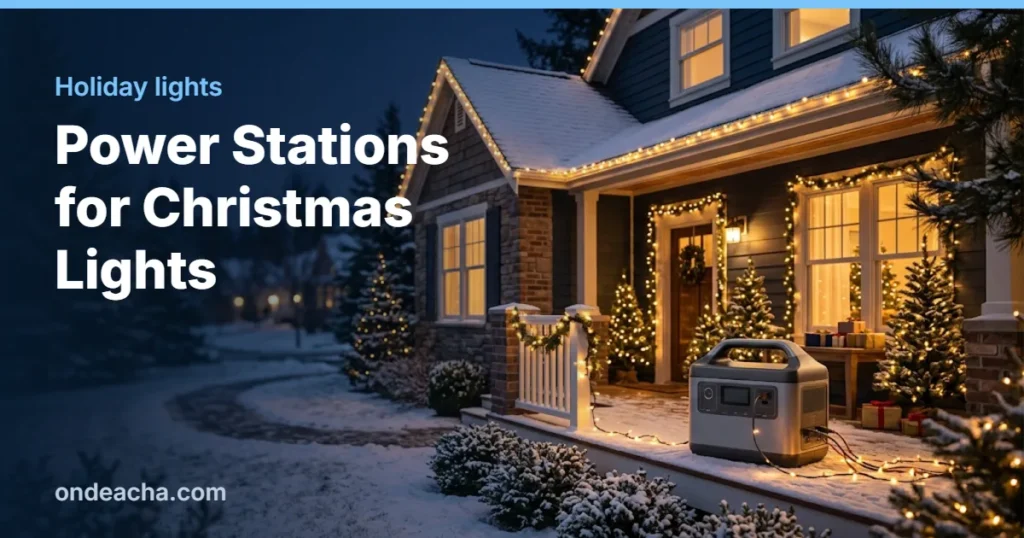
No outlet near the tree in the yard, the mailbox, or the far end of the porch? A portable power station runs Christmas lights with no extension cords across the lawn and no tripped GFCI. LED lights use so little power that a small station can run a full display every night — as long as you use LED, not incandescent. Here’s how to size it.
How much power do Christmas lights use?
| Decoration | Typical draw |
|---|---|
| LED mini lights, 100-bulb strand | About 5–10W |
| LED C9 bulbs, 25-bulb strand | About 3–20W |
| Incandescent mini lights, 100-bulb strand | About 40W |
| Incandescent C9 bulbs, 25-bulb strand | About 150–175W |
| Inflatable (with fan) | About 50–150W |
| Laser / LED projector | About 5–20W |
| Light-up yard figure | About 10–40W |
The watts are printed on the box or the tag near the plug. Strands that connect end-to-end add up — ten LED strands are still only about 50–100W.
How many nights will it run? (Estimates)
Assuming 6 hours a night on a timer. Nightly energy = total watts × 6 hours.
| Display | Total watts | Per night | RIVER 3 (245Wh) | 1kWh station |
|---|---|---|---|---|
| Porch: 4 LED strands | About 30W | About 180Wh | About 1 night | About 5 nights |
| Tree in the yard: 10 LED strands | About 70W | About 420Wh | About 3 hours | About 2 nights |
| Yard: 10 LED strands + 2 inflatables | About 270W | About 1,600Wh | Under 1 hour | About 3 hours |
| Same yard with incandescent strands | About 600W+ | About 3,600Wh | Not practical | About 1.5 hours |
Runtime uses capacity × 0.85 to account for inverter losses. Cold weather can reduce available capacity by 10–20%.
Which power station for your display?
A porch or a single tree: EcoFlow RIVER 3
A few LED strands for one evening, then recharge indoors during the day. Small enough to tuck behind a planter.

A full LED yard: 1kWh station + solar
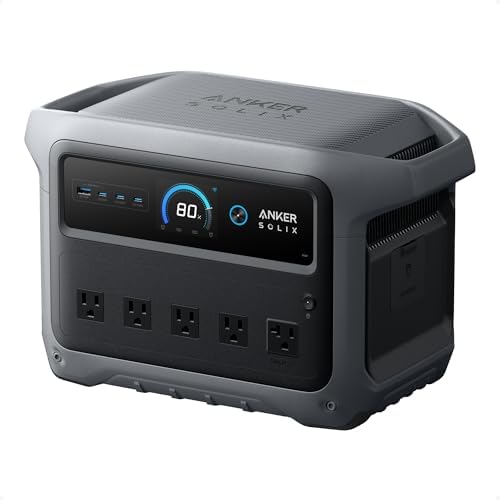
A 1kWh unit runs 10–15 LED strands for one or two nights. Add a 200W solar panel and it can top itself up on sunny days; even in December, 200W of panels usually put back 300–600Wh on a clear day.

Inflatables and big displays: Jackery Explorer 2000 v2
Inflatables run their fans all night and add up fast. 2,042Wh covers a medium yard with a couple of inflatables for one evening.



Setup tips
- Switch to LED. Replacing incandescent strands cuts the load by 80–90% — the single biggest change you can make.
- Use an outdoor plug-in timer. Lights on 5–11 p.m. instead of all night doubles your runtime.
- Keep the station dry. Power stations are not waterproof. Put it in a covered spot, a weatherproof box with ventilation, or inside the garage with an outdoor-rated cord through the door.
- Bring it in on very cold nights to recharge. Most LiFePO4 stations won’t charge below about 32°F (0°C).
- Use outdoor-rated cords and connections, and don’t run them through standing water.
Common questions
Can a power station run Christmas lights all night?
For LED lights, yes: a 1kWh station runs about 100W of LEDs for 8–9 hours. Incandescent strands drain it in an hour or two.
Can I use a battery pack (power bank) for Christmas lights?
Only for USB or battery-style light strings. Standard plug-in strands need a 120V outlet, which means a power station.
Can solar power my Christmas lights?
Yes, through a power station: the panel charges the battery by day, the battery runs the lights at night. Size the panel so a day’s harvest covers a night’s use. Our portable solar panel guide has the math.