
Last updated: October 13, 2026 · Ondeacha is reader-supported. We may earn a commission when you buy through links on this page. Learn more.
Solar panel guides 9 articles
Start here
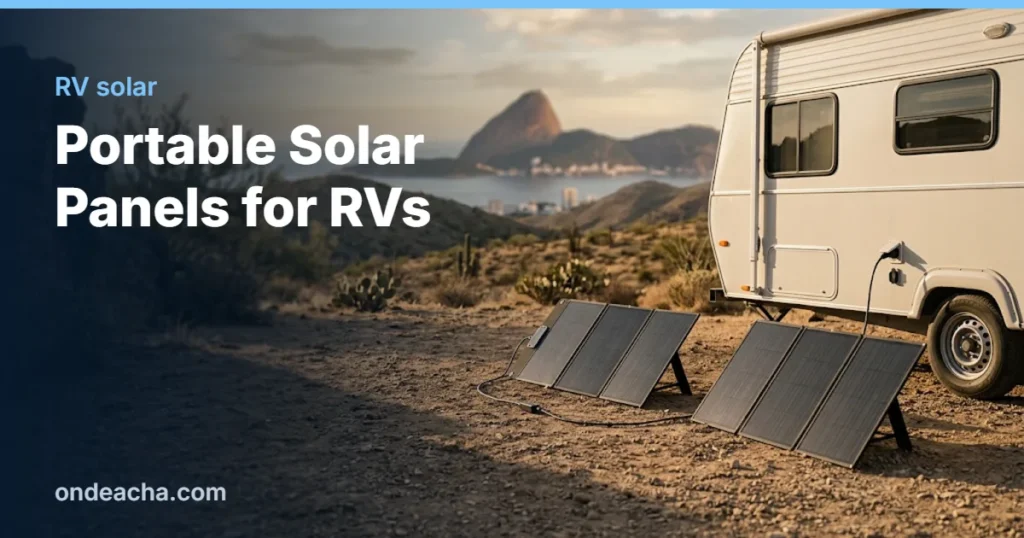
Portable panels (or a ready-made portable RV solar kit) are the easiest way to add solar to a motorhome, camper van, or travel trailer: no holes in the roof, no warranty worries, and you can park in the shade while the panel sits in the sun. The one decision that matters is what you’re charging: a power station, or the RV’s own 12V house battery. They need different panels.
First: what are you charging?
| Your setup | What to buy | Why |
|---|---|---|
| Portable power station (Jackery, EcoFlow, Anker, BLUETTI) | A plain folding panel | The station has its own solar charge controller |
| RV house battery (12V lead-acid or lithium) | A solar suitcase with a charge controller, or a panel plus a separate controller | Connecting a bare panel straight to a battery can overcharge it |
| RV with a “solar ready” port (often a Zamp or SAE plug) | A suitcase kit that matches the port, or the right adapter | Many RV ports already route to a controller; check your manual |




How many watts does an RV need?
RV power use varies more than anything else on this site. A rough guide for boondocking (no hookups), assuming you are not running the air conditioner:
| Use | Typical daily energy | Portable solar to match |
|---|---|---|
| Weekend: lights, water pump, phones, fan | 300–500Wh | 200W |
| Longer trips: add a 12V fridge, TV, laptop | 800–1,500Wh | 400W (2 × 200W) |
| Full-time / remote work: Starlink, CPAP, coffee maker | 1,500–3,000Wh | 600W+ and a 2kWh+ battery |
Daily output ≈ panel watts × sun-hours × 0.75. With 5 sun-hours, 200W gives you about 750Wh and 400W about 1,500Wh.
Best portable panels for RVs
For a power station: Jackery SolarSaga 200W (buy two)
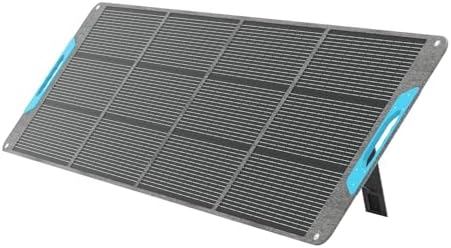
Two SolarSaga 200W panels in series produce about 44V, which fits inside the 60V limit of most 1–2kWh stations and refills a 1kWh unit in a single good day. Each panel is about 14.3 lb, IP68, with a 3+2-year warranty.
Best value for any station: BougeRV 200W N-Type
13.8 lb, 25% N-type cells, and XT60, DC7909, and DC5521 outputs in the box. A pair costs less than one premium 400W panel and is far easier to store in a bay.
For EcoFlow DELTA owners: EcoFlow 220W Bifacial
XT60 straight into the DELTA’s solar port, and the rear side picks up light reflected from gravel, sand, or a light-colored awning. Two in series (about 43V) work on a DELTA 3 Plus, whose two solar inputs accept up to 1,000W combined.
For a 12V house battery: Renogy 100W suitcase with controller
If you want to charge the RV’s own battery, a suitcase kit with a built-in charge controller and battery clips is the simplest route. Renogy’s 100W kit includes a 20A controller. See our Renogy guide for the 200W versions.

Portable vs. roof-mounted RV solar
| Portable panels | Roof-mounted | |
|---|---|---|
| Install | None | Drilling, sealing, wiring |
| Park in shade? | Yes — panel goes in the sun | No — the roof has to be in the sun |
| Aim at the sun | Yes, more output per watt | Flat, about 20–30% less |
| Theft risk | Higher; lock it to the RV | Low |
| Setup each stop | 5 minutes | None |
Many full-timers do both: a modest roof array for trickle charging and one or two portable panels for shaded campsites.
RV solar tips
- Check your station’s limits before wiring in series. Our pairing guide lists them.
- Use a cable lock. Thread it through the kickstand or handle and around a hitch or ladder.
- Use thick extension cable. 10 AWG for runs over 20 ft keeps losses low.
- Store panels flat and dry in a bay, away from sharp objects that can crack cells.
Common questions
Can I plug a portable panel straight into my RV’s solar port?
Only if the port feeds a charge controller and the panel’s connector and voltage match. Many RV ports are Zamp/SAE and expect a suitcase with its own controller. Check your RV manual.
Can portable solar run my RV air conditioner?
Not realistically. A 13,500 BTU AC draws 1,200–1,500W while running; you’d need well over 1,000W of panels and a large battery.
Which power station is best for an RV?
See our larger-capacity picks and the best power stations of 2026.